Saturday, 10 December 2011

Student Profile: Lara Hatley on work experience

Third year Creative Arts for Theatre and Film student Lara Hatley has had a busy time on work experience recently. 


Where?  Factory Settings Ltd. - a scenic fabrication company.


How long?  I did my full 12 weeks there then continued with them throughout summer, overall I spent 6 months working there.

What did you work on?  Numerous projects for theatres, to exhibitions at the V&A as well as travelling exhibitions and plays. 

What did you do?  On each project I undertook a variety of tasks. Whilst there I learnt carpentry and how to make a variety of flats, furniture etc. I also did a lot of painting and scenic painting of the sets and props. I also learnt metal work, leaning how to weld metal together, grind and clean metals and how to contruct metal frames. I also made a stained glass window as well as numerous different props. 

What did you get out of it?  The techniques and methods I picked up from the workers at factory settings were invaluable. Working there enabled me to read technical drawings and apply what i had read into a prop or set. I had never even thought about doing metal work and absolutly loved it and want to do more metal work in the future. I also got to visit theatres to set up the props and sets as well as getting to go "behind the scenes" at the V&A which was a really good experience.  Probably the most valuable thing I got from the work experience was the pace things were made. I could make things so quickly by using the correct techniques, and I saw sets being built in a day whereas in the uni environment you get a much longer deadline.

I personally think that the work experience aspect of the course is the most important part of the 3 years. Not only does it make you more independent as a person having to find the work etc., but it is an experience that readies you for what is to come once the course is over. 
                                                              
 Lara has also  been working on the set of the new film Magwitch, from Viola Films.  


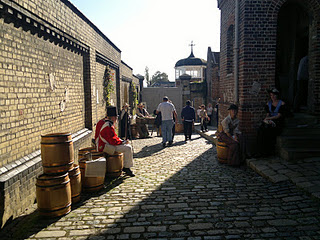
The film is conceived as a prequel to Charle Dickens' 'Great Expectations'.  Here are some photos of work in progress.


The film will receive its world premiere on 11th February 2012 in Rochester Cathedral.  Follow Viola Films on Twitter here.

Thursday, 17 November 2011

Sets, Scenes and Environments: Tintoretto

Tintoretto (1518-94) was a 16th century Venetian painter.  His work is often classed as mannerist because of his stylisation and his use of acute depths of space, but contains many elements of the Baroque - particularly the drama of light and shade.  

His paintings are often on a colossal scale.


Here is the abstract for a Masters thesis by Van Khanh Pham, which discusses Tintoretto as a stage and costume designer:

Tintoretto, one of the great Venetian masters of the sixteenth century, is renowned for his compositional innovations. The painter also worked as a stage and costume designer for the Compagnie della Calza. As a result, he selected and combined elements of other disciplines in his pictures. This thesis focuses on the fusion of the arts in Tintoretto's imagery. A comprehensive analysis of this interdisciplinary aspect reveals the subtlety of Tintoretto's creative mind. The challenge is to discover Tintoretto as a stage designer who conceived pictures as theatrical performances. Instead of the traditional preparatory sketch, he built a miniature stage in order to visualize the scene in tangible forms existing in light and space. The design of the setting, the gestural choreography of his personages and the distribution of lighting were analysed and then translated into painted illusion. With this unusual methodology, Tintoretto invented forceful mise-en-scenes which induce the spectator to perceive the imaginary as real. A substantial knowledge of stagecraft also enabled him to bring to vibrant life the dramatic episodes of the Bible on canvas. Through such artfully constructed theatrical illusion, Tintoretto not only re-creates a vision for his audience, but above all, conveys the depth of his spiritual experience.


The full text of the dissertation can be read by following the link to the pdf here.

Sets, Scenes and Environments: Aki Kaurismaki's 'The Match Factory Girl

Here are some stills from one of Finnish director Aki Kaurismaki's wonderful films, 'The Match Factory Girl'.  Like most of Kaurismaki's films, it focuses on an outsider - here a woman, Iris, who is isolated and unhappy.  She works in a match factory, and lives with her parents.  Kaurismaki's mise-en-scene is richly coloured and composed.

Bleak browns, blues and greys infuse daily life - the flowered patterns are cheap, old and autumnal, but they suggest the possibility of hope.  Iris' pink headband tying back her greasy hair is an assertive note, perhaps an expression of her strength and individuality.


Iris meets a man.  The pink that was confined to her hairband finds full expression in the dress she buys for her date - colour enters her life.


The protagonist's bleak life is turned around when she falls pregnant after the one-night stand.  There is the possibility of a new life, and she prepares to meet her lover to tell him the news.  He brutally rejects her.  Note the baby-clothes colours and bottle of pop with a straw, and how the change in her hair subtly suggests her feelings.


The drama unfolds into a tale of revenge, told with great black humour. Poison is involved.


Here is the compelling opening scene of a match factory production line:


There's an excellent article on Kaurismaki on the Senses of Cinema website here.


Monday, 14 November 2011

The God Delusion

I've been watching the God Delusion with Richard Dawkins on 4OD (channel 4)... Its really interesting. I think it touches on a lot of subjects raised in our lectures including identity/ideology and how our perceptions on religion and our faith in things and people can be affected by our cultural and social backgrounds... anyway here's the link!


http://www.channel4.com/programmes/the-god-delusion/4od

Sunday, 13 November 2011

Sets, Scenes and Environments: Gary McCann's designs for Grimm Tales

Here is British theatre designer Gary McCann's set for 'Grimm Tales', Carol-Ann Duffy's version of the classic tales adapted by Rachel O'Riordan in Manchester, 2009.

There is a wonderful magic realism about the set - inside and outside are seamlessly blended.  Notice the relative sizes of the chairs - the chair at the back appears to fill much more of the space than the chair at the front - telling us that the one-point perspective is highly exaggerated. For an account of how this distorted space worked with the actors, there's review from the Independent newspaper here.


Gary McCann's excellent website (with more images of the Grimm Tales) can be seen here.

Wednesday, 9 November 2011

Costume and Character: Danilo Donati / Pasolini's 'Oedipus Rex' (1967)

Some more costume designed by Italian costume designer Danilo Donati, this time looking at headgear for Pier Paolo Pasolini's 'Oedipus Rex' (1967).  The costumes here share a non-naturalistic aesthetic with those in Fellini's 'Roma', but the effect is quite different.  Here, there is an improvised feel, as if made with a low budget and out of a limited range of available materials.  This helps to give a unique look to the film (note the 'false beard' of Oedipus as well as the unusual crowns) - at once basic and primitive but also unmistakably modern.  Along with the black and white inter-titles used throughout, and the references to modernity in the midst of antiquity, the film has strong elements of Brecht's alienation effect.


The ancient Greek myth of Oedipus is a familiar one.  Oedipus, the king's son, is abandoned as a baby and left to die in the wilderness because of a prophecy that he will kill and replace the king.  He is rescued by a shepherd.  Later in life, he kills the king (not knowing that he is the king, and his original father) in an argument over right of way, and then goes on to solve the riddle of the tyrannical Sphinx and to marry the queen (who doesn't know Oedipus is her son, nor the murderer of the king).  In the fullness of time he finds out what he has done - killed his father the king and married the his mother, the queen.  This shocking revelation causes Oedipus to put out his own eyes, and return to the wilderness in repentance and shame.

Here's a clip of Pasolini's treatment of the story:


There's a good article on Senses of Cinema website about Pasolini here.

Tuesday, 8 November 2011

Costume and Character: Danilo Donati / Fellin's 'Roma' (1972)

Here are some of the influentially extravagant, high camp costumes designed by Italian costume designer Danilo Donati (1926-2001).  Donati designed many costumes (as well as sets) for the great Italian directors Federico Fellini and Pier Paolo Pasolini, amongst others. These are works created for Fellini's 'Roma' (1972), in which life in Rome is depicted and contrasted in the 1940s and the 1970s -  it's a poetic historical essay, rich in satire. 


This is the famous Catholic fashion show scene towards the end of 'Roma',  in which many more of Donati's costumes can be seen: