Showing posts with label sets scenes and environments. Show all posts

Thursday, 17 November 2011

Sets, Scenes and Environments: Tintoretto

Tintoretto (1518-94) was a 16th century Venetian painter.  His work is often classed as mannerist because of his stylisation and his use of acute depths of space, but contains many elements of the Baroque - particularly the drama of light and shade.  

His paintings are often on a colossal scale.


Here is the abstract for a Masters thesis by Van Khanh Pham, which discusses Tintoretto as a stage and costume designer:

Tintoretto, one of the great Venetian masters of the sixteenth century, is renowned for his compositional innovations. The painter also worked as a stage and costume designer for the Compagnie della Calza. As a result, he selected and combined elements of other disciplines in his pictures. This thesis focuses on the fusion of the arts in Tintoretto's imagery. A comprehensive analysis of this interdisciplinary aspect reveals the subtlety of Tintoretto's creative mind. The challenge is to discover Tintoretto as a stage designer who conceived pictures as theatrical performances. Instead of the traditional preparatory sketch, he built a miniature stage in order to visualize the scene in tangible forms existing in light and space. The design of the setting, the gestural choreography of his personages and the distribution of lighting were analysed and then translated into painted illusion. With this unusual methodology, Tintoretto invented forceful mise-en-scenes which induce the spectator to perceive the imaginary as real. A substantial knowledge of stagecraft also enabled him to bring to vibrant life the dramatic episodes of the Bible on canvas. Through such artfully constructed theatrical illusion, Tintoretto not only re-creates a vision for his audience, but above all, conveys the depth of his spiritual experience.


The full text of the dissertation can be read by following the link to the pdf here.

Sets, Scenes and Environments: Aki Kaurismaki's 'The Match Factory Girl

Here are some stills from one of Finnish director Aki Kaurismaki's wonderful films, 'The Match Factory Girl'.  Like most of Kaurismaki's films, it focuses on an outsider - here a woman, Iris, who is isolated and unhappy.  She works in a match factory, and lives with her parents.  Kaurismaki's mise-en-scene is richly coloured and composed.

Bleak browns, blues and greys infuse daily life - the flowered patterns are cheap, old and autumnal, but they suggest the possibility of hope.  Iris' pink headband tying back her greasy hair is an assertive note, perhaps an expression of her strength and individuality.


Iris meets a man.  The pink that was confined to her hairband finds full expression in the dress she buys for her date - colour enters her life.


The protagonist's bleak life is turned around when she falls pregnant after the one-night stand.  There is the possibility of a new life, and she prepares to meet her lover to tell him the news.  He brutally rejects her.  Note the baby-clothes colours and bottle of pop with a straw, and how the change in her hair subtly suggests her feelings.


The drama unfolds into a tale of revenge, told with great black humour. Poison is involved.


Here is the compelling opening scene of a match factory production line:


There's an excellent article on Kaurismaki on the Senses of Cinema website here.


Sunday, 13 November 2011

Sets, Scenes and Environments: Gary McCann's designs for Grimm Tales

Here is British theatre designer Gary McCann's set for 'Grimm Tales', Carol-Ann Duffy's version of the classic tales adapted by Rachel O'Riordan in Manchester, 2009.

There is a wonderful magic realism about the set - inside and outside are seamlessly blended.  Notice the relative sizes of the chairs - the chair at the back appears to fill much more of the space than the chair at the front - telling us that the one-point perspective is highly exaggerated. For an account of how this distorted space worked with the actors, there's review from the Independent newspaper here.


Gary McCann's excellent website (with more images of the Grimm Tales) can be seen here.

Friday, 4 November 2011

Sets, Scenes and Environments: Carl Th. Dreyer's 'Le Passion de Jeanne d'Arc' (1928)

The expressionistic yet minimalist set for Carl Th. Dreyer's silent 1928 film 'Le Passion de Jeanne d'Arc' was designed by Hermann Warm (1889-1976).


Regarded as a key figure in set design for expressionistic film, Warm also created groundbreaking sets for films such as 'Das Cabinet des Dr. Caligari' (Robert Wiene, 1919) and 'Die Spinnen [The Spiders]' (Fritz Lang, 1919-20).


Here are a couple of photos of the original set models for the film.  There are many more fascinating photos of them here (click on the image that says SET MODELS).


These stills give an idea of how the minimalist set is used to create feeling of maximum intensity:


The film itself was lost for decades.  A fire has destroyed the original negative and there were no extant copies.  However, a full copy was discovered in the early '80s in a janitor's cupboard in a mental institute in Oslo. 


As well as the stunning sets, the film itself is also characterised by intensely emotional acting by the lead, Renee Jeanne Falconetti.  She suffered greatly during the shooting of the film, as Dreyer made her enact scenes dozens of times and suppress her feelings to create the emotional temperature he wanted on screen. The camera's focus on her face throughout the film reveals an amazing performance:


The film is extraordinary, and worth watching in full.  Here's a few minutes of it:


Thursday, 3 November 2011

Sets, Scenes and Environments: Yasujiro Ozu

Yasujiro Ozu (1903-1963) is one of the world's great filmmakers.


Ozu was a master of composition.  His films, particularly his postwar films, are renowned for shots which linger on 'empty spaces' for a while, in between the action - so-called 'pillow shots' - they mark time, but also allow the viewer to savour a reflective moment.  These shots are stunning compositions of balance and harmony, and here are a few:


The great historian and critic of Japense film Donald Richie called Ozu a modernist:


"There's this idea of cutting down, of restriction, of making things coherent by making them less, an avoidance of any redundancy and this great ability to make the continuity without all the links, leaving the audience the option, or the necessity to do this. In most Ozu pictures, for example, the wedding is left out. This idea of leaving out these links and testing your audience to make the links with you, or build the bridge halfway to you, these are all attributes of modernism as a literary form. And so, for these reasons, plus a tremendous influence of European photography, that is still photography, or art photography, on Ozu who would use these still lives to make something like he'd already seen in photographic magazines, all of this gives a modernist tinge to everything he did. So there are two things; he's a traditional artist and a traditional aesthetician, because he knew Japanese aesthetics. At the same time he was a real modernist.'


You can read the rest of this interview in Midnight Eye, an interesting online journal about Japanese film, here.

In his excellent current TV series 'The Story of Film', Mark Cousins calls Ozu 'perhaps the greatest director to ever have lived', and I'm inclined to agree.  Here's a great 11-minute introduction to Ozu from the 'The Story of Film':


And a clip (the final scene) from Ozu's last film, 'An Autmun Afternoon' (1962), in which a drunk, upset father realises his own loneliness.  It's a beautiful, melancholy four minutes, with some great 'pillow shots':


Wednesday, 2 November 2011

Sets, Scenes and Environments: Georges de la Tour


As the nights are drawing in, I thought it would apposite to have a look at some night paintings.  Here are a few marvellous paintings by 17th century french artist Georges de la Tour.  La Tour's oeuvre consists almost entirely of paintings of figures by candlelight.  There is a monumental, solemn simplicity in his great canvases.  Little is known about his life but it is assumed he was influenced by Caravaggio.  There is speculation that he may have been influenced by the shallow spaces and lighting of the theatre of his day.


Peter Greenaway cited La Tour as a primary influence on his 1982 film, 'The Draughtsman's Contract':


More information on La Tour can be found on this site.

Friday, 21 October 2011

Sets, Scenes and Environments: Janet Bird

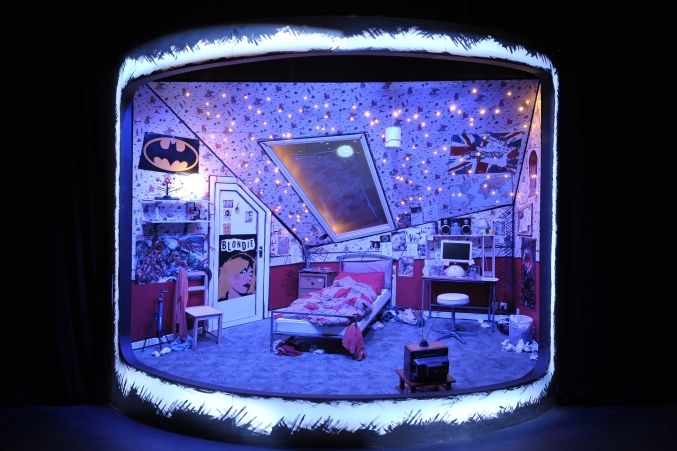
Janet Bird studied Theatre Design at Nottingham Trent University and Scenography at Wimbledon School of Art. Below are her designs for Chris Goode's 'Queer Up North', Ibsen's 'Doll's House' and Michael Frayn's 'Alphabetical Order'.


The expressionistic attic space of the teenager's bedroom in 'Queer Up North', with its starry ceiling and popular culture motifs, contrasts strongly with the austere, everything-painted-grey moodiness of the design for Ibsen'd 'Doll's House'.


Her online portfolio can be found by following this link

Friday, 12 November 2010

Sets, Scenes and Environments: Richard Finkelstein

Students might find some inspiration in the work of Richard Finkelstein here.  Some of the sections on this website show set models or drawings alongside the realised design.  Some also suggest that Finkelstein has adapted narratives to different genres (see the modern dress Geisha costume in the Greek tragedy, Clytemnestra).  Enjoy!


The above are a drawing and fully realised set for Moliere's 'Tartuffe' (1664), transcribed into a more modern (sub)urban genre.